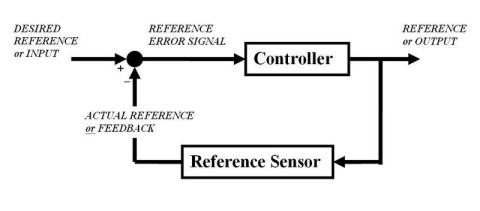
A negative feedback loop senses a condition in a system and sends a signal that reverses any deviation from the normal. The feedback loop controls the dynamic behavior of the output: this is negative feedback because the sensed value is subtracted from the desired value to create the error signal which adjusts the controller to achieve the "desired" output.
Consider an automobile's cruise control, which is a device designed to maintain a constant vehicle speed; the desired or reference speed, provided by the driver. The system in this case is the vehicle. The system output is the vehicle speed, and the control variable is the engine's throttle position.
In a closed-loop control system, a sensor monitors the output (the vehicle's speed) and feeds the data to a controller (computer) which continuously adjusts the control input (the throttle) as necessary to keep the control error to a minimum (to maintain the desired speed). Feedback on how the system is actually performing allows the controller (vehicle's on board computer) to dynamically compensate for disturbances to the system, such as changes in slope of the ground or wind speed. An ideal feedback control system cancels out all errors, effectively mitigating the effects of any forces that may or may not arise during operation and producing a response in the system that perfectly matches the user's wishes.
Excerpted and adapted from: Control theory