Vulcan's Throne is a 500-foot high black cinder cone that rises from the Toroweap Valley floor located on the Esplanade member of the Supai Formation. Loose volcanic cinders flow down the sides and to the base of the cone following precipitation events. The heat-holding, black rocks and cinders augment the summer temperatures.
- Average annual precipitation: Tuweep (4,775 feet elevation at the Ranger Station) has a semi-arid climate, averaging less than 28.91 cm. (11.64 inches) of precipitation a year (www.wrcc 2000). The amount of precipitation has never exceeded twenty inches (1978 had 19.96 inches), with the least precipitation of 4.79 inches recorded in 1956. The station closed in 1985 and reopened in 1989, therefore, there is no precipitation data for the years 1986-88.
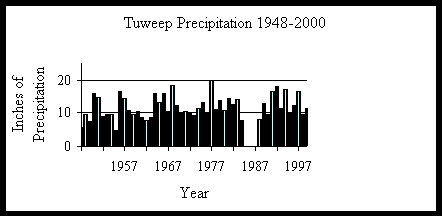
- Summer is normally the season of maximum precipitation, with a secondary peak existing during the winter months. The driest months are May and June, each of which receives less than one-half of an inch of rain. The extreme temperature high is 108 degrees and the low is 6 degrees. (Sellers and Hill 1974).
- Average frost-free season: 273 days (Tuweep)
- Physiographic Province: Grand Canyon Section of the Colorado Plateau Province
- Elevation: 1,290 to 1,341 m (4,250- 4,400 feet)
- Slope (%): about 20 %
- Aspect: southwest facing
- Parent material: basalt
- Soil texture: thin and gravelly cinders with numerous cobbles derived from basalt flows (Lindsay, in preparation)
- Soil pH: 8.0 to 8.4 (Lindsay, in preparation)
- Dept of litter: no litter
- NRCS Soil Map Unit: "130" or Wukoki-Vitrandic Haplocalcid Complex, very deep soils on cinder soils on alluvium and colluvium derived from scoriaceous basalt and pyroclastics (Lindsay, in preparation)
- Vegetation: Xeromorphic, evergreen, Mohave desert scrub with cacti scattered throughout. Plants typically 0.3 to 0.6 m (1-2 feet) tall. Estimated total cover ranges from 15 to 40 percent and is evenly distributed (Warren et al. 1982).
- Biotic Community: Lycium andersonii - Gutierrezia sarothrae - Atriplex confertifolia (Wolf-berry - Snakeweed - Shadscale) 153.11015
- Dominant associated species: Ephedra viridis, Tetradymia canescens, Yucca baccata, Astragalus spp, Baileya multiradiata, and Eriogonum inflatum.
- Also to be found nearby: Salazaria mexicana, Artemisia tridentata, Thamnosma montana, Fendlera rupicola, Opuntia erinacea, Larrea tridentata, Mimulus bigelovii, Eriogonum maculatum, Chaenactis spp, Mentzelia spp, Bromus rubens, Draba spp, Nemacladus spp, Eschscholtzia mexicana, Langlosia setosissima, Eriogonum cernuum, Calochortus spp, and Eriogonum fasiculatum.
- Other Threatened/Endangered species: none in vicinity of known population
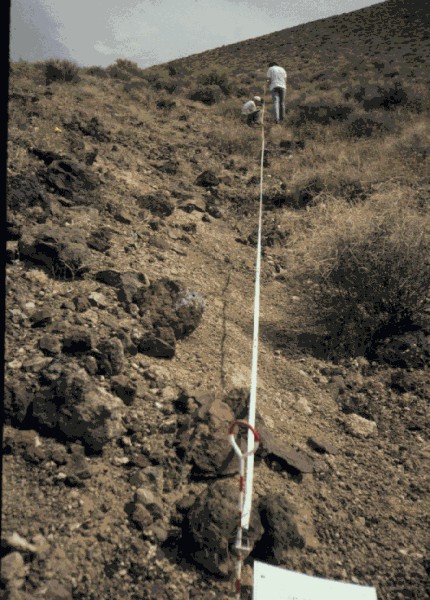
Click on the image for a larger picture.